Wednesday, 19 January 2011

FILM: THE FIGHTER

Elliot Hyams finds out if the new boxing biopic could have been a contender.

A lot has already been written about The Fighter, with some calling it the greatest sports film since Raging Bull, but is it deserving of such high praise? As it reaches our shores the film has already swept up two golden globes and numerous other trophies, predominantly for the performances of its two stars, Mark Wahlberg and Christian Bale. The Fighter is based on the true story of boxer ‘Irish’ Micky Ward, played by Wahlberg. Micky is a down on his luck never-was, managed by his pushy mother and brother Dickie, played by Bale. Fifteen years ago Dickie had been a promising fighter, but a decade long addiction to crack has killed any promise he ever had, and now his lifestyle runs the risk of destroying his brother’s chances of reaching the big time as well. As Dickie falls deeper into a world of addiction and crime, Micky is forced to decide what is more important to him, family or his career.

There can be no doubt that any film that deals with boxing has the shadows of Jake La Motta and Rocky Balboa looming large over it, and this is true in the case of The Fighter. Like Rocky it is a story about a working class hero’s desire to overcome the odds, and like Raging Bull it features a boxer’s epic fall from grace and the destruction of a family as a result of it. But The Fighter has a naturalistic indie feel to it in style, script, and delivery that makes it feel gritty, fresh, and real. Director David O. Russell resists using Scorsese’s visual dramatics, shooting the fights in a broadcast style reminiscent of the coverage of early nineties boxing. Only once does he resort to a slow motion, Raging Bull style in ring montage. But what truly sets this film apart is its story about two brothers each with their own battle to fight. It is the drama that occurs outside of the ring, particularly Dickie’s battle with his demons, that makes The Fighter so engrossing.

It is ironic that in the film Micky feels over shadowed by Dickie as Bale’s performance greatly outweighs Wahlberg’s. Although Wahlberg is sympathetic as Micky, it is Bale who steals the show. He is incredibly believable as Dickie and gives his most compelling performance since The Machinist. The film also features notable performances from Amy Adams and Melissa Leo as Micky’s mother and girlfriend, it’s interesting to see a sports film with strong and well rounded female characters as they are normally painfully absent from the testosterone driven genre. For the most part The Fighter is an enjoyable film and even the most cynical of viewers will find themselves cheering Micky on in the final fight. Whilst it may be true that Micky Ward and his troubled brother won’t become cinematic icons like Jake La Motta or Rocky Balboa, their story is one of hope and redemption that even the most avid sportaphobe can enjoy.

Review by Elliot Hyams

Monday, 17 January 2011

FILM: TRUE GRIT

Elliot Hyams returns to the Wild West as the Coen Brothers try their hand at an American classic.

Who can honestly say the prospect of a remake excites them? Even when a remake is done well it can still leave you wondering what the point was in trying to fix something that wasn’t broken in the first place, and at their worst remakes achieve little more than tarnishing the name of a classic. The major motivation for remakes tends to be vanity, as some arrogant director thinks that they can have a crack at their favourite film, Gus Van Sant please stand up. But he isn’t alone, even the normally Godlike Coen Brothers have fallen foul to the curse of the remake with the awful Tom Hanks version of the Ealing comedy The Lady Killers. A film which most devoted followers of the sibling auteurs would rather just pretend never happened, but it did, which is why the news that they were planning to remake the John Wayne classic True Grit was met with some trepidation.

But we need not have worried, rather than remaking the iconic film itself, the brothers have chosen to adapt the original 1968 novel by Charles Portis. Whilst fans of the film that won Wayne an Oscar for his portrayal of over the hill Marshal Rooster Cogburn will find the story of a determined fourteen year old girl hunting down her father’s killer familiar, this is very much its own film. Jeff Bridges plays Cogburn, but rather than impersonating the Duke he offers his own take on the brutal and often drunk lawman in his winter years. It’s more Bad Blake than Lebowski and he once again proves just how versatile an actor he is. Newcomer Hailee Steinfeld holds her own as Mattie Ross, the young girl who enlists Cogburn to help her find the villainous Tom Chaney, played by Josh Brolin. Rounding up the cast is Matt Damon giving yet another sterling performance as foolhardy Texas Ranger La Boeuf, who much to his chagrin must team with Cogburn and the young girl to find Chaney.

This really is a fantastic film on every level, not only is it brilliantly written and performed, it looks beautiful as well, capturing a moment in the landscape of American history with the same kind of poetic feel that made O Brother Where art Thou such a visual treat. The film stays truer to original text than its predecessor never shying away from the brutal nature of life on the frontier, but there are no cheap kills, every character has a part to play in this complex drama. What truly sets this film apart from any of the other Christmas/New Year/Oscar rush releases is the script, fans of the Coens will know what to expect but for those that still need convincing this film shows what true masters of the craft they are. Characters are well developed, funny, and utterly believable in their interaction which makes for an engrossing experience. Whilst the Wayne version will remain an iconic classic this slice of film perfection certainly deserves a place alongside it.

Review by Elliot Hyams

Thursday, 30 December 2010

FILM: TRON LEGACY

Elliot Hyams returns to the world of sexy programs and killer Frisbees in Tron Legacy.

It’s happened to all of us at some point. A drunken conversation leads to some nostalgic reminiscing about a brilliant film from our youth until finally someone claims to own it on VHS and puts it on. The room falls silent until finally someone says what everyone is thinking “Actually this is a bit shit isn’t it?” One such film that falls under this category is Disney’s Tron. This may be seen as heresy by the many fans of the film, whilst it does deserve recognition for its ground breaking special effects, it featured a ludicrous script and one of the most nonsensical narratives of all time involving Jeff Bridges being sucked into a digital universe to lead a cyber rebellion. But regardless of this, it came to be regarded as an iconic classic with fans just as passionate as any Trekkie or Jedi wannabe. Now nearly thirty years after the release of the original, Disney has once again embraced cutting edge visual technology to take us back to the world of Tron.

After his initial voyage into the grid games designer Kevin Flynn returned to the real world where he took control of software company Encom and fathered a son before mysteriously disappearing. Twenty years later Encom is a mega corporation run by a greedy board of directors much to the chagrin of Flynn’s son Sam. When his father’s best friend Alan receives a mysterious message Sam heads to his father’s office where he is digitized and sucked into the grid. There he encounters Clu 2, a program created by his father twenty years ago who controls the new system as a ruthless dictator. Sam escapes Clu’s clutches with the help of a mysterious program named Quorra who leads him to his father who has remained trapped in the system since Clu defeated Tron and seized control of the grid. Together they attempt to defeat Clu and find their way back to the real world.

Like its predecessor Tron Legacy uses the latest in C.G.I to wage an assault on the senses. The world of the grid is fantastically designed and realised, this combined with an amazing score by Daft Punk make watching this film akin to watching a laser concert, and it is thoroughly engrossing. Fans of Jeff Bridges will be thrilled to know he is on great form both as a CGI enhanced version of his younger self in Clu, but also as the older Flynn who has become a Lebowski style cyber Jedi. Tragically like its predecessor it isn’t a particularly good film, the script draws genuine laughs for the wrong reasons and the gaping holes in the narrative can cause physical pain to a viewer’s brain. But Tron Legacy doesn’t pretend to be anything more than it is, it is pure spectacle and as such it does succeed. It’s sleek and sexy in a way not seen since the Matrix, it features action, light bike chases and everything a fan boy could ever want. In many ways watching this film is like going on a date with Cheryl Cole, she may not have anything intelligent to say, but boy is she nice to look at.

Review by Elliot Hyams

FILM: BLACK SWAN

Elliot Hyams explores the dark side of a dancers psyche with the latest film from maverick director Darren Aronofsky.

Darren Aronofsky has built a career on showing the brutal cost of obsession on the soul. In Pi it was mathematics, in Requiem for a Dream it was heroin, in The Fountain it was Biology, and in The Wrestler it was wrestling. He pulls no punches in his visceral depictions of the gradual descent into catastrophe of his protagonists as they lose themselves to their chosen poison, it can make for hard viewing but he has proven himself to be a director with a clear, if not somewhat bleak view of the world. It is a theme he once again explores in his latest film Black Swan, this time examining the unlikely world of ballet with the same sense of inevitable destruction as he attributed to heroin, maths, and professional wrestling. But this is no ordinary film about ballet it is a slice of psychological horror featuring one of the most unique transformations since Cronenberg’s The Fly.

Natalie Portman stars as Nina, a young and emotionally fragile dancer in Vincent Cassel’s world famous ballet group. When lead dancer Winona Ryder is forced into early retirement by the forceful choreographer Nina realises her dream role of the swan queen in a new version of Swan Lake, however the part requires her to play both the innocent white swan and the evil black swan, requiring a release that she cannot allow. Her maestro’s frustration with her inability to let go, combined with the pressure placed upon her by her overbearing push Nina to breaking point, and things are further complicated by the arrival of Lily, a beautiful and wild dancer who poses a threat to Nina’s spot. Slowly Nina begins to change into something she does not recognise, both physically and mentally as the black swan gradually takes control of her soul.

Just as he did with the world of wrestling Aronofsky captures the shocking toll of ballet on the bodies and minds of those who pursue it as a career. For every shot of a graceful pliƩ or en pointe there is a counter shot of the harm these women endure. We see broken bodies, vomit, blood, and tears. Clearly this obsession is as destructive as any he has previously explored. Like Mickey Rourke before her Portman throws herself into the role, she is utterly convincing as a dancer and her performance carries a weight of tragedy that all but erases the memory of her wooden performance in the Star Wars prequels. Parts of this superbly written film are genuinely shocking, but not just the brutal and fantastically realised transformation scenes. Because Nina is so well realised it is easy to empathise with her so watching her destruction proves as harrowing as any moment from Requiem. If Black Swan is indeed a horror film then it has more in common with the work of Kubrick or Argentino than any of the recent torture porn films that pass for horror these days. Black Swan is a study of repression and obsession, but more than this it is a beautifully constructed film by a fascinating artist.

Review by Elliot Hyams

Tuesday, 28 December 2010

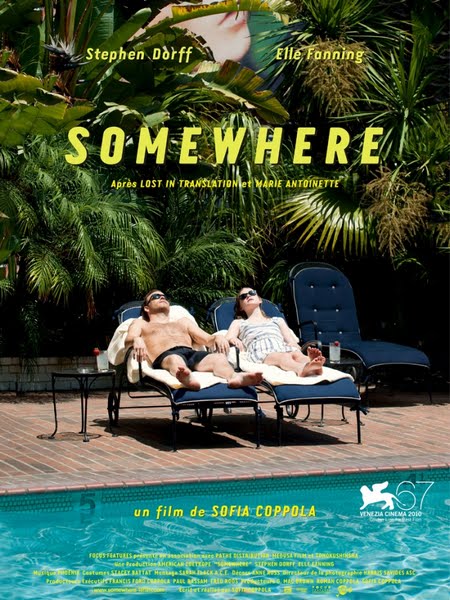
FILM: SOMEWHERE

Elliot Hyams takes a look at the latest film from indie goddess Sofia Coppola.

Since her debut with The Virgin Suicides, Sofia Coppola has carved herself a niche as a filmmaker capable of telling small beautifully crafted stories of isolated and bored individuals. She is not afraid to take risks when it comes to slowing down a narrative to an almost complete stand still, everything she does is calculated and considered and for those who enjoy her work the end process can make for rewarding viewing. She received mainstream accolades for Lost in Translation, a story of romance between a bored over the hill actor and the unappreciated wife of a photographer set against a Tokyo backdrop and this month’s release, Somewhere, sees her returning to similar territory. Somewhere is the story of A-list actor Johnny Marco, played fantastically by Stephen Dorff. Johnny lives a privileged but dull life. In between being ushered to and from shoots and publicity tours, he spends his days drinking and smoking, and his evenings stumbling from one one-night-stand to the next. Whilst this may sound appealing in truth it is not, Johnny’s life is a constant stream of monotonous tedium broken only by visits from his eleven year old daughter Cleo.

Somewhere is a film where not a lot happens, although this may prove frustrating to some viewers it is the whole point of the story. Large parts of the film are still and silent, consisting of Johnny left to his own devices. The opening scene sees him driving his Ferrari repeatedly round an empty race track until boredom sets in and he can do it no more, this is a repeated motif of the film. Johnny does the same things over and over because he doesn’t seem to know what else to do. Dorff plays the part with a bemused vulnerability most perfectly encapsulated in a scene where he returns to the hotel room where he lives to find his best friend throwing a party where Johnny spends most of his time hiding in a corner. Unlike most films about Hollywood this is not a story of excess, it is a story of reality. The relationship between the actor and his young daughter played fantastically by young Elle Fannning is one of the most naturalistic relationships to be put to film in recent years and their interaction is a pleasure to watch.

Despite her skill as a writer it is Coppola’s use of silence that speaks volumes within this carefully constructed narrative, and there is a narrative here. This film is a study of a man without direction and meaning to his life, a man who wishes to be a better person, a better father but is unsure how to go about it. It moves far beyond the themes of loneliness explored in her previous work and into something that is truly beautiful. Somewhere is not a film that everyone will enjoy, many will find tedious and dull, but for those willing to offer it the level of patience and thought it deserves it will prove to be one of the most fascinating and touching films of the year.

Review by Elliot Hyams